Pauli Measurement and Deferred Measurement
Table of contents
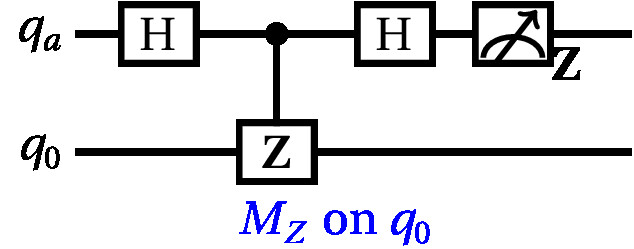
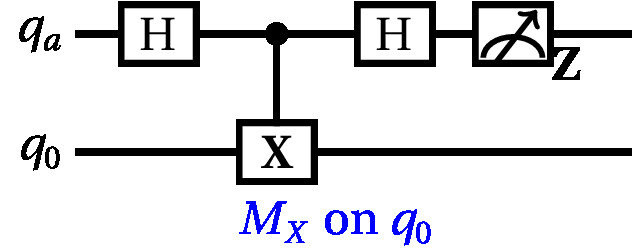
To better understand Pauli measurement, we adopt the ancilla-based description. The advantage of the ancilla-based description is that we can eliminate the measurement symbol from the qubit going to be measured. This representation allows you to generalize the Pauli measurements to multi-qubit case and also provides convenience for reasoning, e.g., the deferred measurement principle.
Single-Qubit Pauli Measurement
Z-axis measurement on \(q_0\):
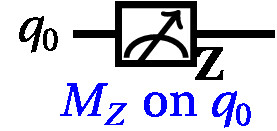 \(=\)
\(=\)
X-axis measurement on \(q_0\):
Y-axis measurement on \(q_0\):
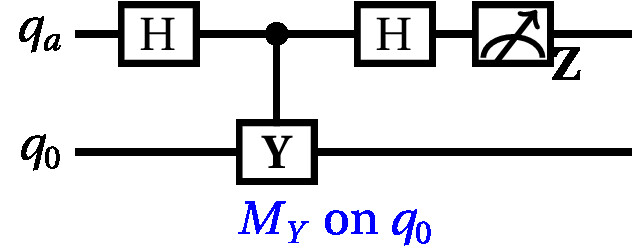 \(=\)
\(=\)
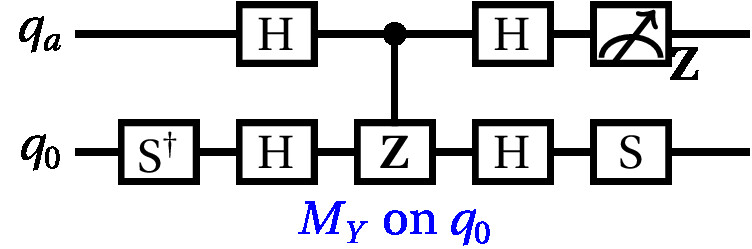
Since \(SHZHS^\dagger=Y\).
Two-qubit Pauli Measurement
Now, using the ancilla-based description, we can easily generate Pauli measurement to multi-qubit case.
\(Z\otimes I\) are just single-qubit Pauli measurement. For the non-degenerated case, we first consider \(Z\otimes Z\).
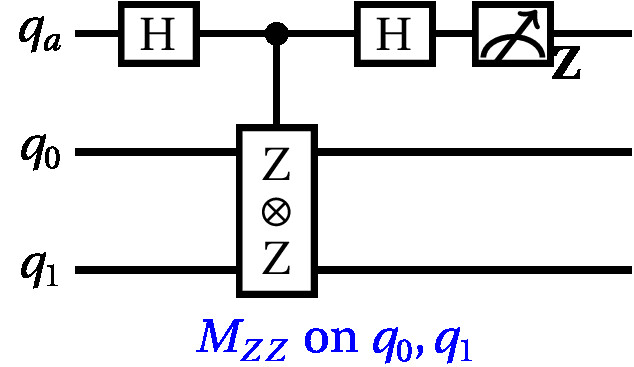 \(=\)
\(=\)
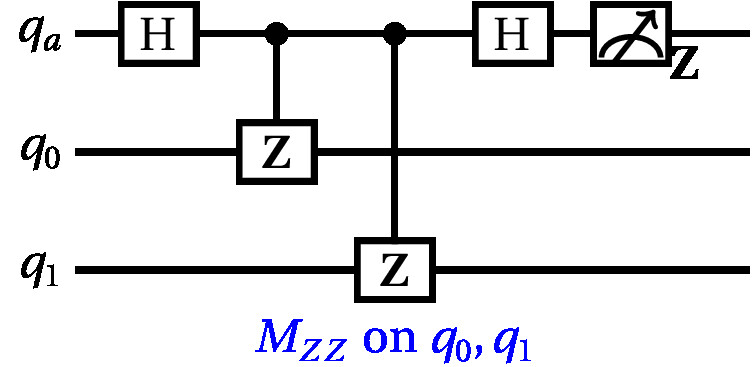
The next step is how we can eliminate the ancilla qubit, i.e., abandon the ancilla-based description?
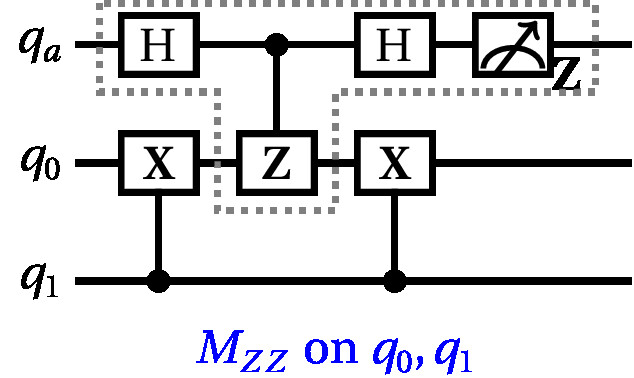 \(=\)
\(=\)
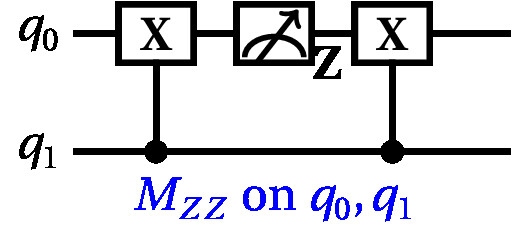
Note that \(CZ\, q_a,q_0;\ CZ\, q_a,q_1=CX\, q_1,q_0;\ CZ\, q_a,q_0;CX\, q_1,q_0\). The final \(CX\, q_1,q_0\) can be omitted if we only care about the measurement result and do not care about the post-measured state.
For Pauli measurement \(X\otimes X\), \(Y\otimes Y\), we can convert them to \(Z\otimes Z\) by axis transformation.
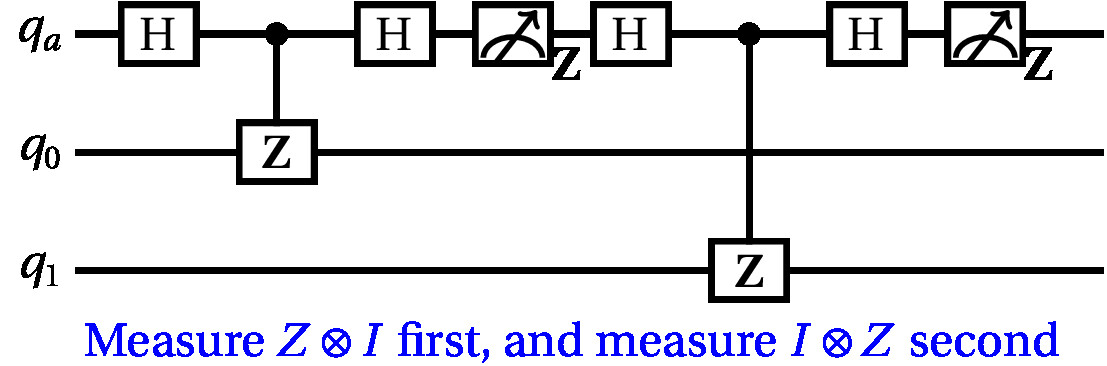
Conventionally, for each Pauli measurement, we prefer to have the real Z-measurement on \(q_0\), as shown in the figures for the Pauli measurement \(Z\otimes Z\). That is, we prefer to convert other Pauli measurement operators to the Pauli measurement \(Z\otimes I\). Thus, for the Pauli measurement \(I\otimes Z\), we need to one SWAP gate to convert it to \(Z\otimes I\).
Finally, note that measure \(Z\otimes Z\) is different from first measure \(Z\otimes I\) and then measure \(I\otimes Z\). This is because measuring \(Z\otimes Z\) will only produce one measurement outcome, while first \(Z\otimes I\) second \(I\otimes Z\) would produce two measurement outcomes. If from the ancilla-based description, we have
\(\ne\)
 .
.
The Deferred Measurement Principle
Using the ancilla-based description of measurement, we can easily understand the deferred measurement principle.
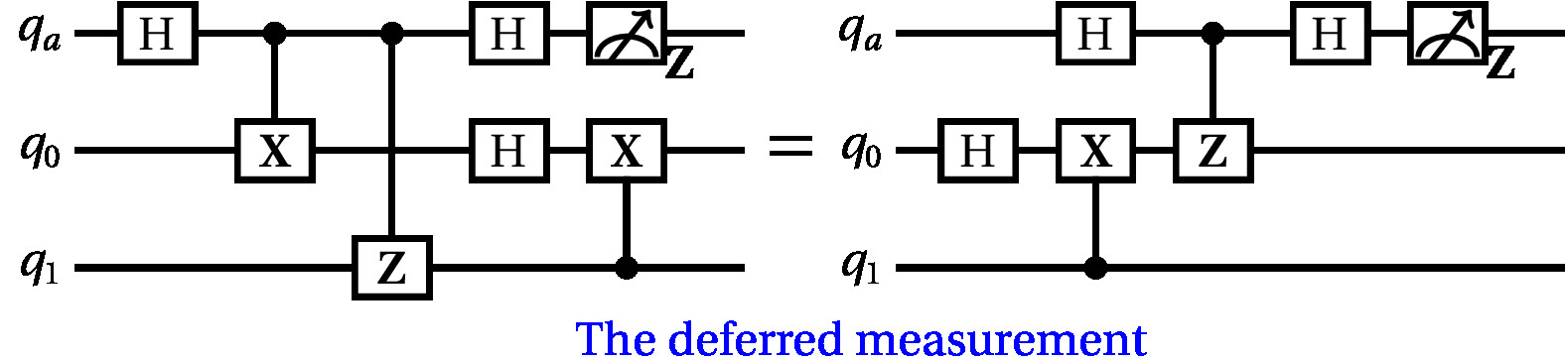
After deferred measurement, the Pauli measurement \(X\otimes Z\) becomes the Pauli measurement \(Z\otimes I\), i.e., \(M_Z\) on \(q_0\).